Retail Pharmacy Navigation Assistant
A Conversation Design Case Study
Designing for uncertainty in a retail pharmacy environment requires more than helpful copy. It requires structure, boundaries, and deliberate conversational flow.
This case study explores how a chat-first navigation assistant can reduce friction when customers don’t know which pharmacy service applies to them. The focus isn’t on answering medical questions — it’s on guiding users toward the right next step with clarity, confidence, and appropriate guardrails.
Project Overview
A conversational assistant designed to help customers who aren’t sure which pharmacy services apply to them identify their needs and take the right next step — without providing medical advice or overstepping professional boundaries.
The Problem
Customers don’t walk into pharmacy chat saying, “I’d like to initiate a prescription transfer.” They show up with uncertainty. They might say:
- “I need help with my prescription.”
- “Do you do vaccines?”
- “I need something for my kid.”
- “Can I refill this?”
- “I have a question about coverage.”
The terminology isn’t always clear, and the available services aren’t always obvious. And for many customers, calling the pharmacy isn’t the preferred option.
Without thoughtful design, that uncertainty turns into friction: wrong selections, unnecessary escalation or conversations that stall before they start.
Assistant Role and Boundaries
This assistant is designed to guide customers toward the right pharmacy service through structured narrowing and intent resolution.
It can:
- Distinguish between refill, transfer and new prescription requests
- Explain vaccine availability at a high level
- Route users to clinic scheduling
- Provide pharmacy hours and location details
- Clarify general insurance and coverage questions
- Connect users with a pharmacist when appropriate
It cannot:
- Diagnose symptoms
- Recommend medication
- Interpret lab results
- Guarantee insurance coverage
- Replace professional medical advice
Clear boundaries aren’t limitations. They help build trust.
Design Approach
Rather than presenting a full menu of pharmacy services, the assistant narrows the conversation step by step. Each prompt offers no more than three options, reducing cognitive overload and helping users move forward without feeling overwhelmed.
When users express low confidence (“I think I need a refill”), the assistant uses explicit confirmation before proceeding. This prevents incorrect intent classification while maintaining conversational momentum.
Empathy shows up in collaborative language (“Let’s narrow it down”) without assuming or naming emotions. The assistant avoids diagnosing, over-explaining or apologizing excessively. Instead, it prioritizes clarity, steady pacing and forward movement.
The goal isn’t to provide every answer. It’s to guide users confidently toward the right next step.
Sample Conversation
User: I’m not sure what I need.
Assistant: That’s okay — we can figure it out together. Is this about a prescription, a vaccine or something else?
Design note: Limits options to three to reduce cognitive load and clarify intent.
User: Prescription.
Assistant: Got it. Are you looking to refill a prescription, transfer one to us or check on an existing order?
Design note: Structured narrowing prevents misrouting and avoids overwhelming menus.
User: I think I need a refill?
Assistant: Just to confirm — you’d like to refill a prescription, correct?
Design note: Explicit confirmation is used when user confidence appears low.
User: Yes.
Assistant: Great. You can refill through your account in just a few steps. Would you like me to take you there?
Design note: Moves toward action while maintaining clarity and momentum.
Handling Uncertainty and Repair
Uncertainty isn’t treated as an error state — it’s expected.
When users respond vaguely (“It’s kind of complicated”), the assistant doesn’t repeat the same prompt or ask for “keywords.” Instead, it progressively adds clarity.
User: It’s kind of complicated.
Assistant: No worries. Can you tell me a little more about what’s going on?
When users move into medical territory, the assistant doesn’t apologize excessively or shut down the conversation.
User: What should I take for a bad cough?
Assistant: I can’t recommend medication, but I can connect you with a pharmacist for advice. Would you like me to do that?
Repair is designed as part of the experience and not a breakdown of it.
Conversation Structure
The interaction (shown below) follows progressive narrowing.
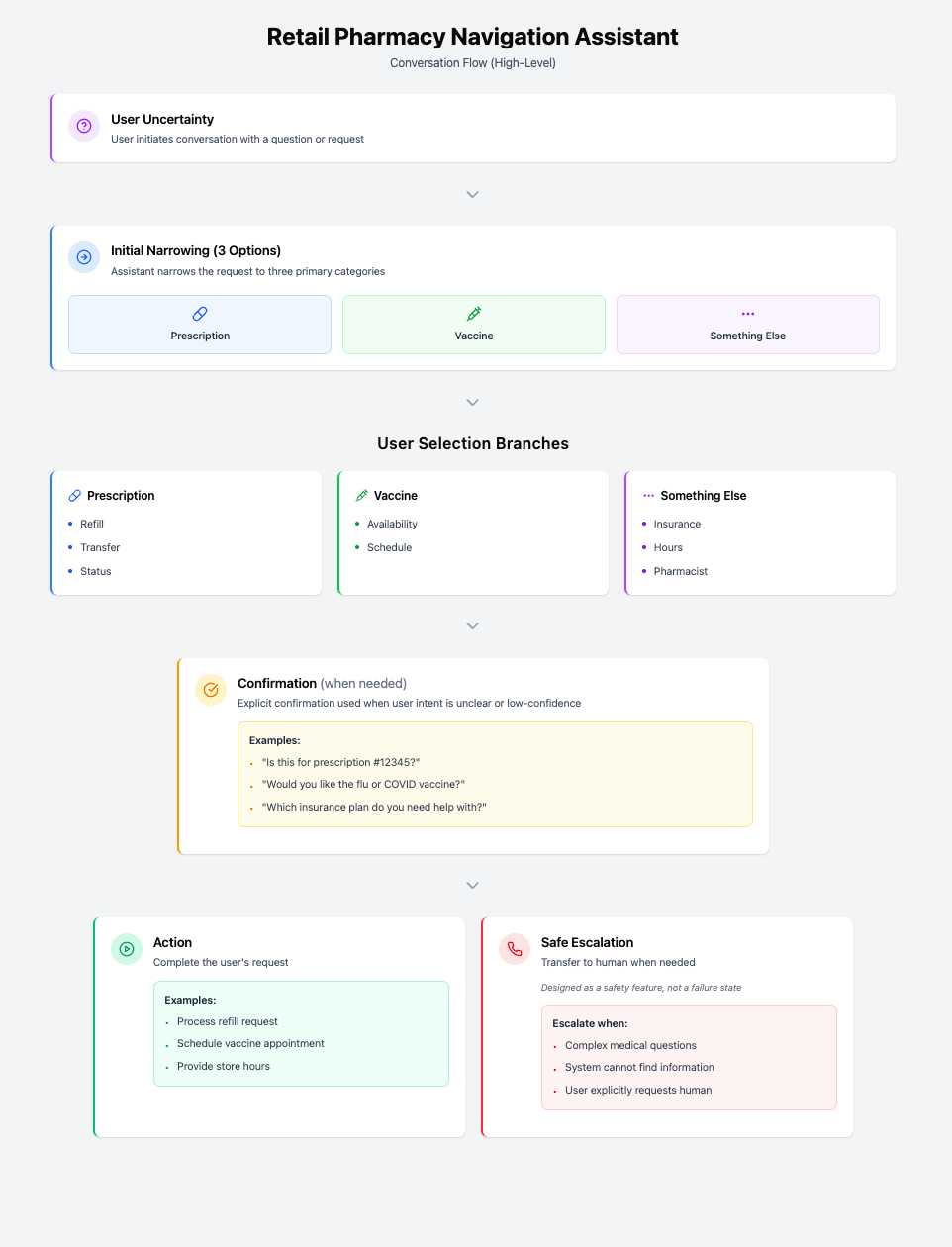
This structure prioritizes clarity over completeness, guiding users toward the right service without overwhelming them.
What I’d Test Next
If deployed, I would evaluate:
- Drop-off rates after the first narrowing prompt
- Frequency of low-confidence language (“I think,” “maybe”)
- Misrouting between refill and transfer
- Escalation rates to live pharmacists
- User satisfaction following repair moments
Future iterations could explore personalization based on prescription history, adaptive narrowing for returning users and reduced repetition for frequent tasks.
